
GALLBLADDER CANCER · SURGICAL ONCOLOGY
Gallbladder cancer — expert surgery, explained clearly
Gallbladder cancer is often found unexpectedly — on a histology report after a routine cholecystectomy, or on a scan done for another reason. When the diagnosis is made, the right surgery at the right time gives the best chance of cure. Dr Ameet Kumar is an AIIMS-trained HPB & GI-oncology surgeon, FRCS (Glasgow), with over 4,500 surgeries across 25 years, who will review your case and advise you clearly.
M.Ch (GI Surgery) AIIMS New Delhi | FRCS (Glasgow) | FAIS | 4,500+ Surgeries
4,500+
Surgeries
25+
Years Experience
56
Publications
FRCS (Glasgow)
AIIMS-trained GI & HPB Surgeon
What is gallbladder cancer?
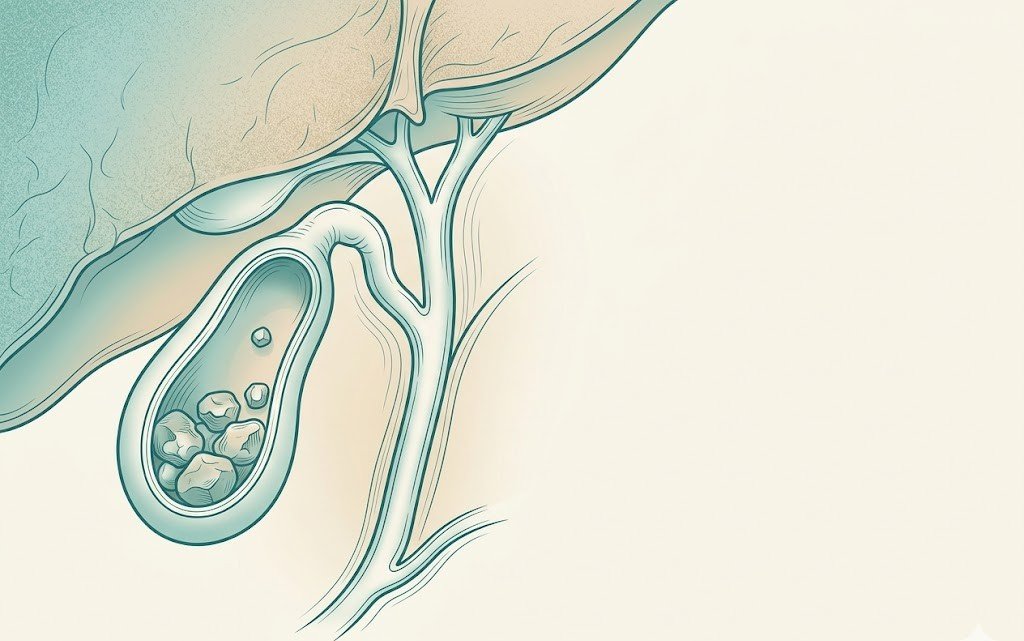
Gallbladder cancer is a malignant tumour arising from the inner lining of the gallbladder. It is the most common biliary tract cancer and tends to be more prevalent in parts of South Asia, including India. The gallbladder sits beneath the liver in the upper right abdomen, storing bile produced by the liver. When cancer arises here, it can remain silent for a long time — which is one reason it can catch both patients and doctors by surprise.
A particularly important pattern in gallbladder cancer is incidental discovery: the cancer is found on the histology (pathology) report after a laparoscopic cholecystectomy (keyhole gallbladder removal) carried out for what appeared to be straightforward gallstones. In these cases, the patient believed they were having a routine operation — and then the laboratory report reveals cancer in the gallbladder wall. This is called incidental gallbladder cancer (IGBC), and it requires prompt specialist reassessment.
When gallbladder cancer grows beyond its early stages, it can spread to the adjacent liver bed (the tissue on the underside of the liver), nearby bile ducts, and regional lymph nodes. Staging this spread accurately — and acting promptly — is central to achieving the best outcome.
Symptoms & red flags
Early gallbladder cancer typically causes no symptoms at all. This is why so many cases are found incidentally, either after surgery for gallstones or on imaging performed for an unrelated problem. When symptoms do appear, they often reflect more advanced disease:
- Upper right abdominal pain — persistent discomfort or aching beneath the right ribcage
- Jaundice — yellowing of the skin or whites of the eyes, indicating bile duct involvement
- Unintentional weight loss — losing weight without trying
- Nausea and loss of appetite
- A palpable lump in the upper abdomen in some cases
- An unexpected cancer report after cholecystectomy — the most important red flag: if your gallbladder removal histology report mentions dysplasia, carcinoma in situ, or adenocarcinoma, you need urgent specialist review
If you have received a histology report following gallbladder removal that mentions cancer — even an early stage — please seek a specialist HPB surgical opinion promptly. Time matters.
Causes & risk factors
The exact cause of gallbladder cancer is not fully understood, but several well-established risk factors are associated with its development:
- Gallstones (cholelithiasis) — long-standing gallstones, particularly large stones (>3 cm), are the most common associated risk factor; chronic irritation from stones is thought to drive malignant change over time
- Gallbladder polyps — polyps larger than 1 cm, sessile polyps, or rapidly growing polyps carry a meaningful risk of malignancy and usually warrant cholecystectomy
- Porcelain gallbladder — calcification of the gallbladder wall (historically thought to carry high risk; evidence now more nuanced, but incomplete calcification patterns warrant specialist review)
- Chronic gallbladder inflammation — including chronic cholecystitis, primary sclerosing cholangitis, and anomalous pancreaticobiliary duct junction
- Female sex and older age — gallbladder cancer is more common in women and increases with age
- Geography and ethnicity — rates are higher in parts of North India, South America, and East Asia
How gallbladder cancer is diagnosed
Diagnosis typically involves a combination of imaging, blood tests, and pathology. The approach depends on how the cancer presents:
- Ultrasound — often the first investigation; can identify gallbladder wall thickening, masses, or polyps
- Contrast-enhanced CT scan — essential for staging; assesses local extension, liver involvement, lymph nodes, and distant spread
- MRI / MRCP — particularly useful when bile duct involvement is suspected
- Review of prior cholecystectomy histology — for incidental cases, the pathology report from the removed gallbladder is the starting point; the T-stage (depth of invasion) drives subsequent management
- CA 19-9 and CEA — tumour markers that can support the diagnosis and help monitor response, though neither is diagnostic alone
- Multidisciplinary tumour board (MDT) — all cases are discussed at a specialist tumour board before a treatment plan is finalised, bringing together HPB surgery, oncology, radiology, and pathology
Treatment options
Surgery is the only curative treatment for gallbladder cancer, and the extent of surgery required depends on the stage of the cancer.
- Radical (extended) cholecystectomy — the standard curative operation for resectable gallbladder cancer. This involves removing the gallbladder together with a wedge (margin) of adjacent liver tissue (the gallbladder bed) and dissecting the regional lymph nodes. Achieving clear surgical margins is the primary goal. In some cases, bile duct resection and reconstruction is also required.
- Re-resection after incidental gallbladder cancer — when cancer is discovered on histology after a simple laparoscopic cholecystectomy, the initial surgery was not designed with oncological margins in mind. Depending on the T-stage (depth of invasion), re-staging and a second, definitive radical re-resection operation is often required. This is a time-sensitive decision that requires HPB surgical expertise.
- Adjuvant chemotherapy — chemotherapy after surgery may be recommended in selected cases, particularly for more advanced-stage resected tumours, and is decided in the multidisciplinary team setting.
- Palliative care — when cancer is diagnosed at an advanced, unresectable stage, the focus shifts to controlling symptoms, managing jaundice (with biliary stenting if needed), and maintaining quality of life. Dr Kumar will always be honest about what surgery can and cannot achieve.
How Dr Kumar treats gallbladder cancer
Dr Ameet Kumar is an HPB and GI-oncology surgeon with specific experience in the full spectrum of gallbladder cancer management — from early-stage incidental findings to radical resection for established tumours. His approach combines technical precision with honest, unhurried communication.
- Expert in the incidental-gallbladder-cancer pathway — Dr Kumar is practised in the re-staging and re-resection pathway for incidentally found gallbladder cancer: reviewing the original histology, determining T-stage, organising appropriate cross-sectional imaging, and deciding with the MDT whether and when radical re-resection is required
- Radical cholecystectomy — performs radical (extended) cholecystectomy including liver bed resection and regional lymphadenectomy, with the goal of clear (R0) resection margins
- MDT planning — all cases are reviewed at a multidisciplinary tumour board before surgery; oncology, radiology, and pathology input is integral to every treatment plan
- Honest counselling — Dr Kumar believes in clear, unambiguous conversations about what surgery involves, what it can realistically achieve, and what the alternatives are; you will leave the consultation knowing exactly where you stand
- Consultant — Sakra World Hospital, Devarabeesanahalli, Bengaluru — Dr Kumar sees patients at Sakra World Hospital, Bengaluru; contact details below
da Vinci Robotic Surgery
Now also available with robotic assistance
For selected patients, gallbladder cancer surgery is now also available using the da Vinci robotic surgical system. Its 3D magnified vision and wristed instruments help with precise dissection around the liver bed and porta hepatis, and the potential benefits include less blood loss, less pain and a shorter hospital stay. Open, laparoscopic and robotic approaches are all available — Dr Kumar will recommend whichever gives you the safest, most complete result for your case.
Recovery & follow-up
Radical cholecystectomy is a significant but well-tolerated operation in fit patients. Patients should have clear expectations before the procedure:
- Hospital stay — typically 4–7 days for radical cholecystectomy, depending on the extent of liver resection and whether bile duct reconstruction was required
- Return to light activity — most patients are mobile and managing daily tasks within 2–4 weeks; full recovery typically takes 6–8 weeks
- Diet — a low-fat diet is advisable in the weeks after surgery; most patients tolerate a normal diet within 4–6 weeks
- Structured follow-up — regular imaging (CT or MRI), tumour marker monitoring (CA 19-9, CEA), and oncology review are arranged to detect any recurrence early and manage it promptly
Outcomes depend on the stage at which the cancer is found and the completeness of surgical resection. Dr Kumar will discuss realistic expectations with you at every stage of the journey.
Frequently asked questions
Most gallbladder cancers in India are found in one of two ways. The first is incidentally — on the histology report after a laparoscopic cholecystectomy done for gallstones, where the patient had no prior suspicion of cancer. The second is on imaging (usually an ultrasound or CT scan) done for abdominal symptoms, where a gallbladder mass, wall thickening, or suspicious lesion is picked up. Early-stage cancers found incidentally carry a better prognosis than symptomatic, advanced-stage tumours.
This is a frightening situation, but it is not uncommon — and it is manageable if acted on promptly. The first step is a consultation with a specialist HPB surgeon who has experience in this pathway. The histology report will describe the T-stage (depth of invasion through the gallbladder wall). For T1a cancers (superficial, confined to the inner lining), the original cholecystectomy may be sufficient. For T1b and beyond, re-staging imaging and a second operation (radical re-resection) is usually advised. Do not delay: seek a specialist opinion within days, not weeks.
A radical cholecystectomy (also called extended cholecystectomy) goes further than a standard gallbladder removal. It involves removing the gallbladder together with a wedge of the adjacent liver tissue (the gallbladder bed, typically 2 cm) and a formal dissection of the regional lymph nodes along the hepatoduodenal ligament. The aim is to achieve an oncologically clear (R0) resection — meaning no cancer cells left at the margins. It is typically performed as an open or laparoscopically assisted operation, and most patients are hospitalised for 4–7 days.
Yes — when gallbladder cancer is found at an early stage and completely removed with clear margins, cure is achievable. Incidentally found early-stage cancers (T1 and T2) that are treated with appropriate surgery carry meaningful prospects for long-term disease-free survival. Advanced-stage cancers found late — when the tumour has spread widely — are harder to cure, but even here, an honest specialist assessment is worthwhile to determine whether any surgical option exists. The single most important factor is getting the right operation done at the right time, with clear margins.
Gallstones are strongly associated with gallbladder cancer — the vast majority of patients with gallbladder cancer also have gallstones. However, most people with gallstones do not develop cancer; the overall risk is low, though it rises with large stones, long duration, and chronic inflammation. The association is thought to be causal: chronic irritation from stones damages the gallbladder lining over time and can trigger malignant change. This is one of the reasons symptomatic gallstones that persist are generally best treated by removing the gallbladder rather than leaving it indefinitely.
Not always — but it depends entirely on the T-stage (depth of tumour invasion) reported in the histology. For T1a cancer (confined to the inner mucosa), a simple cholecystectomy with clear margins may be curative on its own. For T1b (invasion into the muscle layer) and beyond, the evidence strongly favours radical re-resection to achieve adequate margins and lymph node staging. A specialist HPB surgeon should review every incidental gallbladder cancer report, regardless of stage, to make this determination. Acting quickly is important: further surgery is best done within 4–6 weeks of the original operation.

Written & medically reviewed by Dr Ameet Kumar, M.Ch (GI Surgery, AIIMS), FRCS (Glasgow), FAIS. Last updated: June 2026.
Gallbladder cancer, or an unexpected cancer report after surgery? Let’s review it.
Whether you have received a new diagnosis, an unexpected histology report after cholecystectomy, or imaging showing a suspicious gallbladder lesion — Dr Kumar will review your case, explain your options clearly, and advise you on the next step. Prompt specialist assessment is essential. Book a consultation or reach his team directly on WhatsApp.
Call 9606028116