
PANCREATIC CANCER & TUMOURS · SURGICAL ONCOLOGY
Pancreatic cancer & tumours — expert surgery, explained honestly
A pancreatic diagnosis is frightening. But when a tumour is found in time, surgery offers the best chance of cure — and not every tumour is inoperable. Dr Ameet Kumar is an AIIMS-trained HPB & GI-oncology surgeon, FRCS (Glasgow), with over 4,500 surgeries across 25 years, who will tell you clearly where you stand.
M.Ch (GI Surgery) AIIMS New Delhi | FRCS (Glasgow) | FAIS | 4,500+ Surgeries
4,500+
Surgeries
25+
Years Experience
56
Publications
FRCS (Glasgow)
AIIMS-trained GI & HPB Surgeon
What pancreatic cancer & tumours are
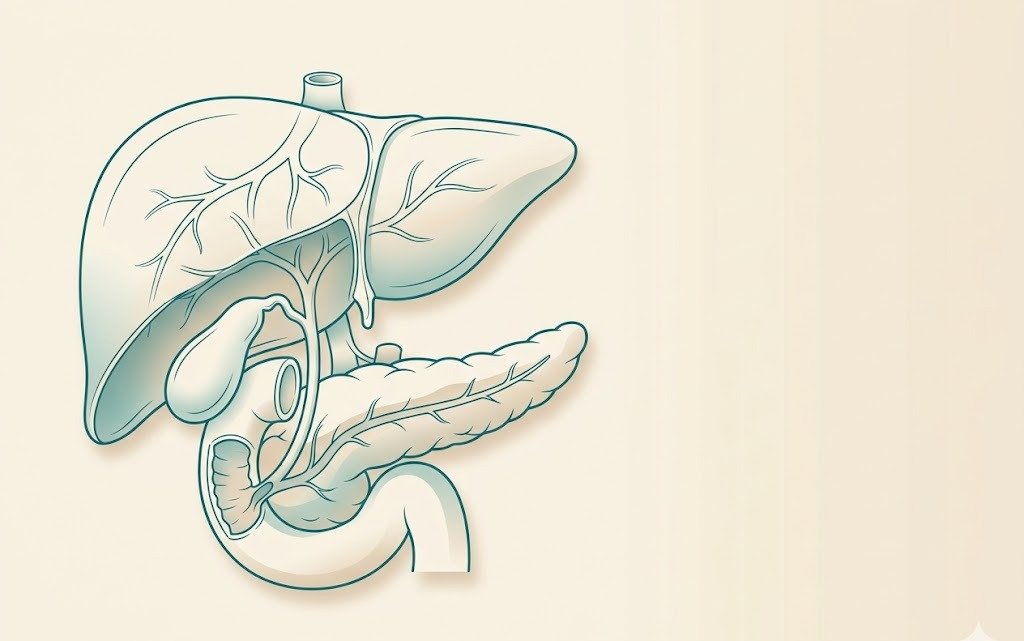
The pancreas is a gland tucked behind the stomach that produces digestive enzymes and insulin. When abnormal cells grow within it, the result is a spectrum of diseases — some aggressive, some slow-growing, some curable. The most important types are:
- Pancreatic adenocarcinoma — the most common type, arising from the ductal cells; requires urgent surgical assessment.
- Neuroendocrine tumours (NETs) — often slower-growing; many are surgically curable even at a later stage.
- Cystic tumours (IPMN, MCN) — fluid-filled sacs that can progress to cancer; careful surveillance and timely surgery prevent malignant transformation.
- Periampullary tumours — cancers arising at or near the junction of the bile duct, pancreatic duct, and duodenum; prognosis is often better than pancreatic adenocarcinoma.
The location of the tumour within the pancreas — head, body, or tail — determines the operation needed. A thorough staging work-up establishes what is possible before any decision is made.
Symptoms & red flags
Pancreatic cancer can be silent in its early stages. When symptoms appear, prompt assessment matters. See a specialist if you notice:
- Painless jaundice — yellow eyes or skin, dark urine, pale stools (a tumour in the head of the pancreas blocking the bile duct)
- Unexplained weight loss — significant, rapid loss without dieting
- Upper-abdominal or back pain — a deep, persistent ache that may be worse lying down
- New-onset diabetes — especially in those over 50 with no other risk factors
- Loss of appetite and fatigue — persistent and unrelated to another cause
None of these symptoms is specific to pancreatic cancer — but each one warrants prompt evaluation. If a tumour is present, earlier assessment means more surgical options.
Causes & risk factors
No single cause triggers pancreatic cancer, but several factors increase risk:
- Smoking — the single most modifiable risk factor
- Chronic pancreatitis — longstanding inflammation raises lifetime cancer risk
- Family history — first-degree relatives with pancreatic cancer or BRCA mutations
- Long-standing diabetes — particularly when poorly controlled over many years
- Obesity and sedentary lifestyle
- Age — most cases occur after 60, though younger presentations do occur
Having a risk factor does not mean you will develop pancreatic cancer, and many patients have none. If you are concerned, a focused assessment including imaging can provide clarity.
How it’s diagnosed
Accurate staging is the foundation of treatment planning. The key investigations are:
- CT pancreas protocol (triple-phase) — the primary staging scan; defines tumour size, vascular involvement, and distant spread
- Endoscopic ultrasound (EUS) with biopsy — when tissue diagnosis is needed before treatment
- MRCP — detailed mapping of bile duct and pancreatic duct involvement
- CA 19-9 tumour marker — useful for monitoring response to treatment; not reliable for diagnosis alone
- Staging and resectability assessment — the single most important question: can this tumour be removed with clear margins?
- Multidisciplinary tumour board (MDT) — Dr Kumar presents complex cases at MDT to ensure the treatment plan draws on surgical, oncological, and radiological expertise
Treatment options
Surgery (the only curative treatment when the tumour is resectable)
- Whipple’s procedure (pancreaticoduodenectomy) — for tumours in the head of the pancreas or periampullary region; removes the head, duodenum, part of the bile duct, and gallbladder
- Distal pancreatectomy — for tumours in the body or tail; minimally-invasive (laparoscopic) approach is well-established and Dr Kumar uses it where oncologically appropriate
- Total pancreatectomy — when the tumour spans the gland or multifocal disease requires complete removal
When surgery is not immediately possible
- Neoadjuvant chemotherapy — for borderline-resectable tumours, chemotherapy can shrink the tumour to allow surgery; response is re-assessed with repeat imaging
- Adjuvant chemotherapy — after surgery, to reduce the risk of recurrence
- Palliative biliary stenting or surgical bypass — for advanced tumours causing jaundice or gastric outlet obstruction, to restore quality of life
How Dr Kumar treats pancreatic cancer
Dr Ameet Kumar is a high-volume HPB and GI-oncology surgeon with M.Ch (GI Surgery) from AIIMS New Delhi and FRCS (Glasgow) — one of the most demanding qualifications in surgery. Over 25 years and 4,500+ operations, he has performed Whipple’s procedures, distal pancreatectomies, and complex vascular reconstructions for pancreatic cancer.
- Minimally-invasive where appropriate — laparoscopic distal pancreatectomy, laparoscopic staging, and minimally-invasive reconstruction are used when they serve the patient’s oncological interests
- Careful patient selection — not every patient with a pancreatic mass benefits from surgery; Dr Kumar will tell you honestly if observation, biopsy, or non-surgical treatment is the right path
- Honest counselling — you will receive a clear explanation of what the scans show, what surgery can and cannot achieve, and what the alternatives are
- MDT-planned care — complex cases are reviewed at tumour board before treatment begins
da Vinci Robotic Surgery
Now also available with robotic assistance
For selected patients, pancreatic surgery — including the Whipple’s procedure and distal pancreatectomy — is now also available using the da Vinci robotic surgical system. Its 3D magnified vision and wristed micro-instruments help with precise dissection around major blood vessels and careful reconnection, with the potential for less blood loss and a faster recovery. Open, laparoscopic and robotic approaches are all available — Dr Kumar will recommend whichever gives you the safest, most complete result for your case.
Recovery & outcomes
Pancreatic surgery is major surgery, and honest expectations matter:
- Hospital stay — typically 7–10 days after Whipple’s; 4–6 days after distal pancreatectomy
- Return to normal activity — most patients are back to light activity within 4–6 weeks; full recovery takes 3 months
- Pancreatic enzyme supplements — most patients require pancreatic enzyme replacement therapy (PERT) after surgery to aid digestion; tablets with meals
- Diabetes management — blood sugar is monitored carefully; some patients develop new-onset diabetes after pancreatectomy and will need insulin or medication
- Structured follow-up — regular CT scans, CA 19-9 monitoring, and oncology review to detect any recurrence early
Outcomes depend heavily on stage, margin status, and biology. Dr Kumar will discuss realistic expectations before any procedure — not after.
Also managed: pancreatitis & pancreatic cysts
Not every pancreatic condition is cancer. Acute pancreatitis, chronic pancreatitis, and pancreatic cysts (including pseudocysts, serous cystadenoma, IPMN, and MCN) are all assessed and managed here. Many cysts are benign and need only surveillance; others warrant surgery to prevent malignant change. Dr Kumar will advise clearly which applies in your case.
Frequently asked questions
Yes — when the tumour is detected while still confined to the pancreas and resectable (removable with clear margins), surgery offers the best and only curative option. Survival rates are significantly better for patients who have a complete surgical resection compared to those who do not. The key question is always whether the tumour is resectable — and that requires proper staging, not assumption. Not every tumour that looks daunting on a scan is inoperable.
The Whipple’s procedure (pancreaticoduodenectomy) removes the head of the pancreas together with the duodenum, part of the bile duct, and the gallbladder, then reconnects the digestive tract. It is the standard curative operation for cancer of the head of the pancreas and periampullary tumours. It typically takes 5–8 hours and requires 7–10 days in hospital. Recovery at home takes 6–8 weeks before returning to full activity. It is a major undertaking — but in experienced hands it is safe and offers the best chance of cure.
For distal pancreatectomy (body and tail tumours), laparoscopic (keyhole) surgery is now well-established and Dr Kumar uses it where oncologically appropriate. Keyhole distal pancreatectomy offers a faster recovery, less pain, and a shorter hospital stay compared to open surgery. The Whipple’s procedure for head tumours is technically more complex; the minimally-invasive approach is available in select cases and is discussed individually. Dr Kumar will advise which approach is right for your tumour based on imaging and staging.
CA 19-9 is a blood tumour marker that is elevated in many patients with pancreatic cancer — but it is not a reliable screening test. It can be raised in benign conditions (pancreatitis, bile duct stones, liver disease) and is normal in around 10% of people with pancreatic cancer (Lewis antigen negative). A raised CA 19-9 is most useful when interpreted alongside imaging and in monitoring response to treatment or detecting recurrence. A single elevated result without other findings should not cause panic — but it does warrant prompt specialist review and repeat imaging.
No — the majority of incidentally discovered pancreatic cysts are benign and require surveillance rather than immediate surgery. Serous cystadenomas very rarely become malignant and can often be watched. The cysts that carry meaningful malignant potential are IPMNs (particularly those involving the main pancreatic duct) and mucinous cystic neoplasms (MCNs). Surgery is recommended when high-risk features appear on imaging or EUS. Dr Kumar will review your imaging, advise the cyst type, explain the risk, and recommend the appropriate path — whether that is surveillance, EUS, or surgery.

Written & medically reviewed by Dr Ameet Kumar, M.Ch (GI Surgery, AIIMS), FRCS (Glasgow), FAIS. Last updated: June 2026.
Facing a pancreatic cancer or tumour diagnosis? Let’s review your scans together.
Whether you have a new diagnosis, a borderline-resectable report, or imaging that needs expert interpretation — Dr Kumar will review your case and tell you honestly where you stand. Early assessment makes all the difference. Book a consultation or message his team on WhatsApp.
Call 9606028116